House washing in the Salt Lake Valley
Pressure washing and soft washing — the pressure matched to the surface, not the other way round.
A house does not get dirty evenly. The south wall fades, the north and east walls grow the grey-green film that makes a place look years older than it is, and the trim quietly collects everything the roof sheds. Ember washes all of it — pressure washing where a surface can take the force, soft washing where it cannot. Siding, stucco, brick and painted trim are mostly soft washed: low pressure, the right cleaning solution, and time left to do the work, which is what gets a wall clean without driving water behind it. It is the same crew and the same standard as the glass, and if you want both, the house comes first and the windows after.
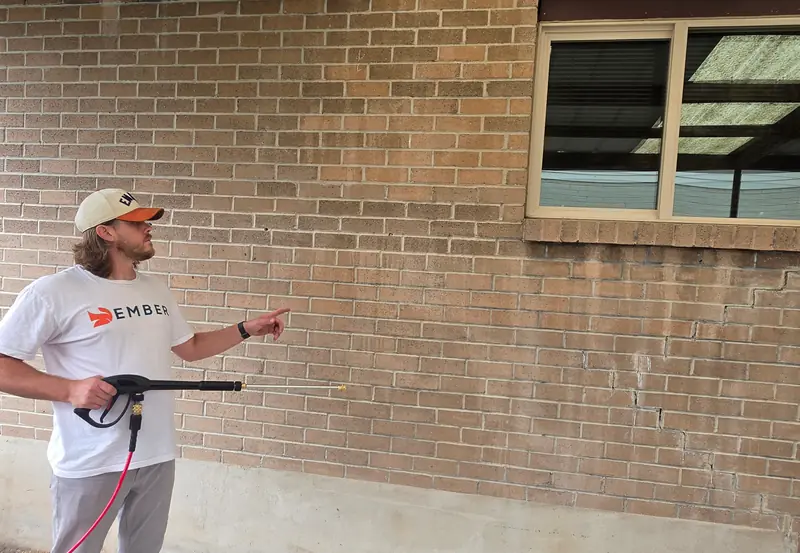
How a house gets washed
- 1
Walk the house and read the surfaces — siding, stucco, brick, painted trim and anything that needs keeping dry
- 2
Pre-wet and protect plants, light fittings and anything that should not take spray
- 3
Soft wash where the surface is porous or painted: low pressure, the right cleaning solution, dwell time doing the work
- 4
Rinse top down and check the shaded walls last, because that is where the film hides.
What gets washed, and how hard
The surface decides the pressure. That is the whole craft of it.
Vinyl & fibre-cement siding
Soft washed. Low pressure and a cleaning solution lift the grey-green film without forcing water behind the boards.
Stucco
Soft washed, always. Stucco is porous and full pressure drives water into it — the solution does the work instead.
Brick & masonry
Pressure matched to the mortar. Sound brick takes more; older or crumbling mortar takes far less.
Painted trim, soffits & fascia
The lowest pressure on the house. Paint and old caulk lift under a hard stream, so these get the gentlest pass.
Driveways, walkways & patios
The flat concrete that can take real pressure — the other half of what we wash, covered on its own page.
Decks & fences
Read before they are touched. Wood tells you quickly how much it will take, and we work under that.
Quoted in person
House washing does not have a posted price, and we would rather say so than invent one. What a house costs depends on what it is made of, how many storeys it is, how much of it there is and how much growth is actually on the walls — and those vary far more between two houses on the same street than a window count ever does. Our team looks at it and gives you a figure before anything starts.
Do the house, then the glass
House washing pairs with driveway and patio pressure washing, gutter cleaning and window cleaning — and in that order, so nothing that comes off the walls dries on clean windows.
House washing across the Salt Lake Valley
Taylorsville out through the whole valley and the cities below.
- Salt Lake City
- Alpine
- Alta
- American Fork
- Bluffdale
- Bountiful
- Brighton
- Cedar Hills
- Copperton
- Cottonwood Heights
- Draper
- Emigration Canyon
- Herriman
- Highland
- Holladay
- Kearns
- Lehi
- Magna
- Midvale
- Millcreek
- Murray
- Park City
- Pleasant Grove
- Riverton
- Sandy
- South Jordan
- South Salt Lake
- Taylorsville
- West Jordan
- West Valley City
- White City
Our guarantee
If anything isn't right, we come back and fix it. If you're still not happy, we refund you.
House washing questions
Do you pressure wash houses, or only driveways?
Both. Ember pressure washes and soft washes homes as well as flat concrete. The difference is not whether we will touch a house, it is how much pressure the surface can take — concrete can take a lot, siding and stucco cannot, so a house is mostly soft washed rather than blasted.
What is the difference between pressure washing and soft washing?
Pressure washing does the work with force. Soft washing does it with a cleaning solution and time, at a pressure closer to a garden hose. On a driveway, force is fine and fast. On siding, stucco or painted trim, force is what drives water behind boards, strips paint and etches the surface, so the solution is left to break down the growth and then rinsed off. Most of a house is soft washed for that reason.
How much does house washing cost?
It is quoted in person, and we would rather tell you that than guess at a number. A house is priced on what it is made of, how many storeys it is, how much of it there is and how much growth is actually on it — and those vary far more between two houses on the same street than a window count does. Our team looks at it and gives you a figure before anything starts.
Will it damage my siding or paint?
Not when the pressure is chosen for the surface, which is the entire point of soft washing. The damage people have seen from house washing — water behind siding, stripped paint, furred wood, etched stucco — comes from using driveway pressure on a wall. We read the surfaces first and work under what they will take, and anything that should stay dry is covered or pre-wet before we start.
What about my plants and garden beds?
They are pre-wet before any solution goes on the wall and rinsed afterwards. Wetting a plant first means a cleaning solution cannot soak into dry soil around the roots, and the rinse carries off whatever lands on the leaves. Anything delicate gets covered instead.
When is the best time of year for it?
Spring and autumn are the easiest — mild temperatures let a solution dwell properly, and the shaded north and east walls have had a season to grow the film that makes a house look tired. Summer works too. Hard freezes are the one thing we schedule around.
Can you do the windows at the same time?
Yes, and it is the right order to do it in: wash the house first, clean the glass after, so nothing that comes off the walls ends up drying on clean windows. Mention both when you ask for a quote and our team will price them together.